
Cover Up Tattoos in Berlin Expert Guide to Transforming Old Ink

That old tattoo doesn’t have to stay on your skin as a daily reminder of a bad decision, a rushed design, or an artist who didn’t quite get it right. A well-planned cover-up can turn faded lines, awkward symbols, and heavy black patches into body art you actually want to show.
At Leon Tattoo & Piercing in Berlin Pankow and Weißensee, cover-up work is one of the places where experience really matters. Our artists bring 17+ years of tattooing experience to custom cover-up design, which means we don’t just place a bigger tattoo over an old one and hope for the best. We study the existing ink, the skin, the shape of the body, and the new idea, then build a design that works in real life.
If you’re looking for a Cover-up Tattoo Berlin solution, this guide will help you understand what’s possible, what isn’t, and how to get the best result.

What a cover-up tattoo actually is
A cover-up tattoo is a new tattoo designed to visually hide, reshape, or transform an existing tattoo.
That sounds simple, but good cover-up work is part art, part technical problem-solving. Old ink sits under the skin, so the new design has to account for what’s already there. The artist can’t erase the tattoo with fresh ink. They have to work with it.
A successful cover-up usually does one or more of these things:
Uses darker tones over darker areas
Black, deep grey, dark blue, deep red, and rich green can help mask older pigment.
Redirects the eye
Strong composition, movement, shading, and highlights can pull attention away from the original shape.
Builds a new design around the old tattoo
The best cover-ups don’t look like cover-ups. They look intentional.
Expands the overall size
A cover-up often needs more space than the original tattoo so the new design can breathe.
For example, a small faded name might become part of a rose stem, a dark ornamental piece, a raven feather, or a black and grey floral design. A patchy tribal tattoo might turn into a larger sleeve element with smoke, leaves, skulls, geometric details, or animal forms.
The goal isn’t only to hide the old tattoo. The goal is to create a piece that looks like it always belonged there.
Why people want to cover old tattoos
There’s no single reason people walk into the studio asking for a cover-up. Sometimes the tattoo is technically poor. Sometimes it’s tied to a past relationship. Sometimes the design just doesn’t match the person anymore.
That’s normal. Taste changes. Skin changes. Life changes.
Faded tattoos lose their impact
Tattoo ink naturally changes over time. Sun exposure, skin renewal, ageing, placement, and the original ink quality all affect how a tattoo looks years later.
Common issues include:
Blurry outlines
Patchy black areas
Washed-out colour
Loss of detail
Grey or greenish tones where black used to be sharp
A tattoo that looked crisp at 22 might look tired at 35. This is especially common with fine-line tattoos, small script, and pieces that didn’t have enough contrast from the start.
Cover-up design can bring structure back to that area of the body. Instead of trying to “repair” every weak line, the artist can create something stronger and more balanced.
Outdated designs stop feeling like you
Some designs belong to a specific time in someone’s life. That old symbol, band logo, quote, or trend-based tattoo may not feel right anymore.
Berlin is full of people with stories. Expats who moved here for a fresh start. Locals who got their first tattoo as teenagers. Travellers who picked up spontaneous pieces abroad. A cover-up can turn that old chapter into something new without pretending it never happened.
Popular transformations include:
Old names into floral or ornamental work
Small symbols into animals, masks, mandalas, or abstract forms
Old-school pieces into larger black and grey compositions
Patchy colour tattoos into darker, richer designs
Random small tattoos into connected sleeve or leg concepts
Bad tattoo work can be fixed with the right plan
Not every tattoo heals or ages well. Some were poorly applied from the beginning.
Signs of bad tattoo work can include:
Blowouts, where ink spreads under the skin
Uneven line weight
Scarred skin
Poor proportions
Weak shading
Unclear shapes
Colours that healed muddy
A cover-up can help, but it needs honest planning. Scar tissue, very dark ink, and raised lines all affect the result. That’s why an in-person consultation or clear photos are so useful. The artist needs to see what the skin is actually doing.
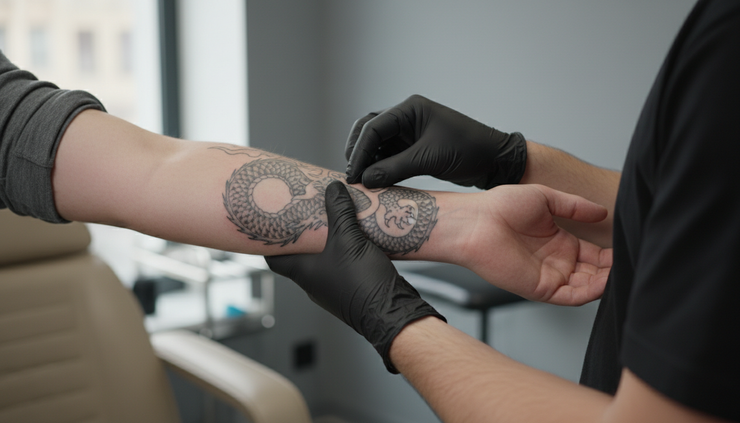
How our artists transform unwanted tattoos into new body art
At Leon Tattoo & Piercing, the process starts with the old tattoo, but it doesn’t stop there. A cover-up has to fit the person wearing it.
A good artist will look at:
The size of the old tattoo
How dark the existing ink is
Where it sits on the body
The direction of the muscles and joints
The client’s style preferences
Skin tone and how contrast will read after healing
Whether the area has scarring or raised texture
How much flexibility there is with the new design
This is where custom design matters. A cover-up pulled from a flash sheet rarely works well because it wasn’t built for the old tattoo underneath.
The first step is reading the old tattoo
Before sketching the new piece, the artist studies the existing tattoo like a map.
They look for the darkest points, the strongest lines, and the shapes that need to disappear. Sometimes one part of the old tattoo can be hidden directly. Other parts may need to be disguised with texture, shadow, or movement.
For example:
A dark horizontal line may become part of a branch, feather, or shadow.
A faded circle might become the centre of a flower or ornamental pattern.
Uneven script may sit under smoke, fur, leaves, or black and grey shading.
Red or blue pigment may need deeper colour saturation to fully settle the new piece.
This is why two tattoos of the same size can need completely different cover-up solutions.
The new design needs to flow with the body
Organic flow is one of the biggest differences between an average cover-up and a great one.
Rounded body parts, like shoulders, upper arms, calves, and thighs, need designs that move naturally. If the cover-up fights the shape of the body, it can look heavy or awkward.
Our artists often use natural and flowing elements because they’re useful for hiding old ink while still looking beautiful:
Flowers and leaves
Animals and wings
Smoke and clouds
Hair, fur, scales, and feathers
Abstract black and grey textures
Ornamental curves
Dark realistic compositions
These elements allow the artist to create soft transitions, deep shadows, and strong focal points. That makes the old tattoo much harder to spot.
Technical rules that make cover-ups work
A cover-up isn’t just “put black over it.” In fact, that approach often creates a flat, heavy result. The strongest cover-ups use contrast, placement, and design structure.
Cover-ups often need to be larger than the original
This is one of the first things to understand.
The new tattoo usually needs to extend beyond the old one. Why? Because the artist needs room to create a fresh shape, add shadows, and distract the eye from the original design.
If the new tattoo is exactly the same size as the old one, the design options become limited. It can turn into a dark patch instead of a strong piece of art.
A larger cover-up gives space for:
A clear focal point
Smooth shading
Light and dark contrast
Natural movement
Background elements
Better balance on the body
As a rough idea, many cover-ups work best when the new design is noticeably bigger than the old tattoo. The exact size depends on how dark and dense the original ink is.

Black and grey shading can hide old lines beautifully
Black and grey work is powerful in cover-ups because it gives the artist a wide range of tones. Deep black can cover the darkest parts of the old tattoo, while soft grey can create smooth transitions.
Good black and grey cover-ups often use:
Heavy shadows where old ink is darkest
Soft gradients to avoid harsh blocks
Texture to break up old shapes
Negative space where skin can still show
Strong contrast so the piece doesn’t look muddy
Think of it like lighting in a black and white photo. The eye follows contrast. If the artist controls the contrast well, the original tattoo becomes visually unimportant.
Deep colour saturation can overpower faded ink
Colour cover-ups can work very well, especially when the old tattoo is faded or lightly applied. But colour choices have to be smart.
Basic colour theory matters. Darker pigments usually cover lighter ones more reliably. Warm colours may not hide deep black or dark blue on their own. Pale tones, like yellow or light pink, won’t magically cover a heavy black tattoo.
Strong cover-up colours can include:
Deep red
Dark green
Burgundy
Navy tones
Dark purple
Rich brown
Saturated orange in the right areas
Colour can also help build a new mood. A tired old tattoo can become a bold neo-traditional piece, a dark floral design, or a dramatic animal tattoo with strong shadows.
Some tattoos need preparation before the cover-up
Not every tattoo is ready to cover right away. If the old piece is very dark, very large, or packed with black ink, the artist may suggest lightening it first before tattooing over it.
That isn’t always necessary, but it can open up better design options.
For example, lightening a dense black name or symbol can make it easier to cover with detailed work instead of forcing a very dark design. This is something to discuss during the consultation. The best plan depends on the tattoo, the skin, and the final style.
What styles work best for cover-up tattoos
There’s no one perfect style for every cover-up. The right style depends on the old tattoo and the new goal. Still, some styles give artists more freedom.
Black and grey realism
Black and grey realism works well because it uses shadows, depth, and texture. Faces, animals, skulls, statues, flowers, and dark natural elements can all hide old shapes when designed properly.
This style is especially useful for medium to large cover-ups where the original tattoo has strong black lines.
Floral and botanical designs
Flowers, leaves, vines, and branches are popular for a reason. They have natural curves, layered petals, and flexible shapes.
They can wrap around old tattoos and create a clean flow across the arm, shoulder, ribs, thigh, or back.
Dark ornamental and abstract work
Ornamental designs can cover old tattoos with symmetry, pattern, and bold black areas. Abstract black and grey work can be even more flexible because it doesn’t need to follow a fixed subject.
This can be a good choice when the original tattoo is awkwardly placed or hard to disguise with a realistic image.
Animal designs with texture
Animals offer a lot of useful cover-up tools. Fur, feathers, scales, eyes, horns, and shadows all help hide old ink.
Popular options include:
Ravens and eagles
Wolves and big cats
Snakes and dragons
Owls
Koi fish
Moths and butterflies with darker wings
The key is to avoid forcing the animal shape onto the old tattoo. The design has to be built around both the body and the existing ink.

What to expect during a cover-up consultation in Berlin
A cover-up consultation is practical and relaxed. You don’t need to arrive with everything figured out. It helps if you know what you don’t want, but the artist can guide the rest.
At Leon Tattoo & Piercing, located at Berliner Allee 72, 13088 Berlin in Pankow and Weißensee, the consultation focuses on what will actually work on your skin.
Bring or send:
Clear photos of the current tattoo
A photo from slightly farther away so the artist can see placement
Any reference images for the style you like
Notes about size, placement, and budget expectations
Information about scarring, touch-ups, or previous cover-up attempts
If you’re travelling through Berlin and have limited time, it’s smart to message first. Cover-ups often need more planning than walk-in tattoos.
You can also send photos of your current tattoo via WhatsApp for a free assessment. Good photos help the artist tell you whether the idea is realistic, what size may be needed, and whether an in-studio consultation would be better.
If you’ve searched for Fix old tattoo Berlin, Leon Tattoo Berlin is ready to help you plan a cover-up that feels intentional, not rushed.
How to get the best result from your cover-up
Cover-ups are a team effort between client and artist. The more flexible the plan, the stronger the final tattoo usually is.
Stay open on size
Wanting the smallest possible cover-up is understandable. But too-small cover-ups often look cramped or too dark.
If the artist recommends going larger, it’s usually because they need space to create a better design. A larger, flowing tattoo often looks lighter and more natural than a small, dense patch.
Be flexible with the design
Some ideas simply won’t cover certain tattoos well. A pale fine-line design won’t hide a dark tribal piece. A tiny script tattoo won’t cover a thick black symbol unless it becomes part of a bigger composition.
Good cover-up subjects give the artist tools to work with:
Dark and light areas
Texture
Movement
Overlapping shapes
Strong focal points
That doesn’t mean giving up your idea. It means adapting it so it works.
Trust contrast more than detail
Tiny details don’t hide old tattoos. Contrast does.
A strong cover-up needs readable shapes from a normal viewing distance. Details can add beauty, but the basic structure has to work first.
Before approving a design, ask yourself:
Can I read the main shape clearly?
Does the tattoo flow with the body?
Are the darkest parts placed where the old tattoo is darkest?
Does the design look good even if I don’t know it’s a cover-up?
Follow aftercare carefully
Fresh cover-up tattoos need proper healing. The skin has already been tattooed before, and some areas may be more sensitive, especially if there’s scarring.
Follow the aftercare instructions from your artist. Keep the tattoo clean, avoid picking, avoid soaking it while healing, and protect it from sun exposure once healed. Sun is one of the biggest reasons tattoos fade over time, so long-term care matters too.
When a cover-up might not be the best first step
Most unwanted tattoos can be improved, but a direct cover-up isn’t always the smartest route.
The artist may suggest another plan if:
The tattoo is extremely dark and dense
The old ink covers a large area
The skin is heavily scarred
The desired new design is much lighter than the old tattoo
The placement limits the flow of the new piece
The tattoo has already been covered once before
That doesn’t mean there’s no solution. It just means the best result may take stages. Sometimes that includes lightening, reworking, expanding into a larger piece, or turning a small cover-up idea into a bigger custom project.
Honesty at this stage saves disappointment later.
Why experience matters so much in cover-up tattooing
Cover-up work is less forgiving than tattooing clean skin. The artist has to think ahead, because every line and shadow has a job.
With 17+ years of experience in custom cover-up design, our artists understand how healed tattoos behave, how old pigment can show through, and how to build designs that still look strong years later.
Experience helps with:
Choosing the right subject for the old tattoo
Knowing when black and grey will work better than colour
Placing shadows without making the tattoo too heavy
Designing around scars and uneven skin
Creating movement that hides old shapes
Saying no to ideas that won’t heal well
That last point matters. A good cover-up artist won’t just agree to anything. They’ll guide the design toward the best possible result.

Ready to turn old ink into something better
A cover-up tattoo can do more than hide an old design. It can give that part of your body a fresh start.
Maybe the tattoo is faded. Maybe it reminds you of the wrong time. Maybe the linework was never good. Whatever the reason, the right artist can turn unwanted ink into a custom piece with depth, flow, and meaning.
If you’re in Berlin, drop by Leon Tattoo & Piercing at Berliner Allee 72, 13088 Berlin, in Pankow and Weißensee for a consultation. Or send clear photos of your current tattoo on WhatsApp for a free assessment.
Bring the old tattoo. Bring the story if you want to. We’ll help you figure out what can become of it.
Comments